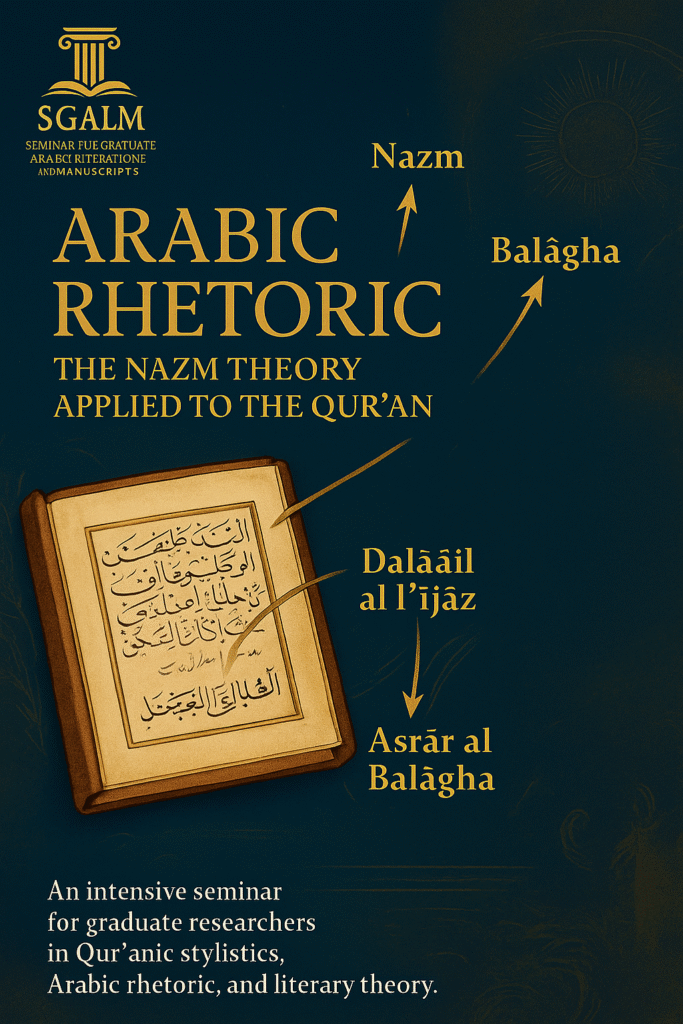
This seminar does not aim to reiterate the conventional classifications of Arabic rhetoric—such as sajʿ (rhymed prose), istiʿārah (metaphor), and tashbīh (simile)—as merely a taxonomy of rhetorical devices. Rather, it seeks to offer advanced academic training in the application of the theory of nazm (semantic composition) to Qur’anic texts.
Study Problem
To critique the excessive formalism that characterizes many traditional and modern rhetorical studies.
To focus on applied analytical skills, rather than on repetitive categorizations.
To surpass superficial terminology by grounding interpretation in meaningful textual construction.
The Philosophy of Arabic Rhetoric
Methodological Framework
A historical introduction to the debates on “wording and composition” (lafẓ wa-nazm) before ʿAbd al-Qāhir al-Jurjānī, focusing on Abū Hilāl al-ʿAskarī (d. 395 AH / 1005 CE) and Ibn Sinān al-Khafājī (d. 466 AH / 1073 CE).
A critical reading of al-Jurjānī’s conception of nazm, separating the essence of the theory from mere terminological labeling.
An analytical induction of the semantic and rhetorical mechanisms underpinning the theory, as articulated in his two foundational works:
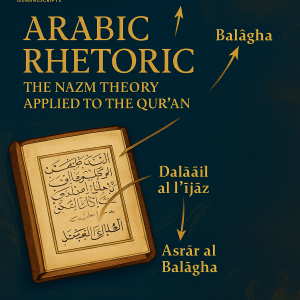
Asrār al-Balāgha (The Secrets of Eloquence)
Dalāʾil al-Iʿjāz (The Proofs of Inimitability)
Topics of Study
The semantic and historical dimensions of the term balāgha in Arabic linguistic culture.
The crisis of meaning and composition in Abū Hilāl al-ʿAskarī.
The problematic of wording and meaning in Ibn Sinān al-Khafājī.
The intellectual architecture of al-Jurjānī’s theory of nazm.
Deriving and articulating the operational principles of the theory from his major works.
Applied Workshop
At the end of the seminar, students will be required to submit a miniature academic paper, based on the following structure:
A clearly articulated research question and introduction
Definition of the methodological approach
Application of the theory to selected Qur’anic passages